
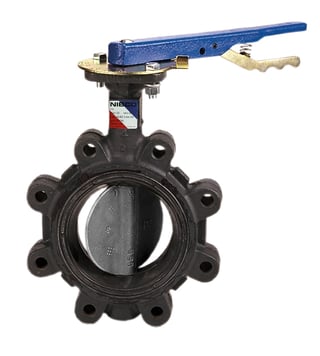
Butterfly valves are a versatile solution for bi-directional dead-end service in commercial, industrial and mechanical HVAC applications. When selecting butterfly valves for your next project, consider these key factors to ensure optimal performance and value. NIBCO supports your selection process with specification and submittal assistance, a robust warranty, and expert customer service.
Key Selection Criteria
Connection Types: Choose from wafer, lug, grooved, or press-to-connect ends to match your system requirements.
Size Range: Benefit from a broad selection of sizes to fit any application.
Material Options: Select from ductile iron, cast iron, or CPVC for durability and compatibility. Lead-free and fire-protection options are available.
Performance: High-performance models deliver reliable operation and bubble-tight shut-off.
What Sets Butterfly Valves Apart?
1. Long Operating Life
Modern butterfly valves offer maintenance-free cycles and maintain bubble-tight shut-off over time.
2. Energy Efficiency
Minimize energy costs by reducing pressure drop. Butterfly valves outperform globe valves (3X better flow) and offer about 75 percent of the flow of an equivalent gate valve. Consider piping flow area, friction loss, and directional changes when designing your system.
3. Versatility
Butterfly valves can be used for on/off service and throttling/balancing. They are superior in "versatility" as compared to a gate or globe valve. Butterfly valves have a wider range of chemical resistance due to the various trim options and liner options.
4. Lightweight Design
Save on installation dollars costs with lightweight butterfly valves compared to heavyweight cast-iron valves. For example, a 10" butterfly valve typically weighs just 55 pounds, while a 10" iron gate valve can weigh up to 490 pounds. This difference can result in significant savings when calculated across an entire system. Heavier systems require stronger and more expensive pipe hangers. By considering valve weight, you can also reduce overall piping system costs.
5. Compact Size
Butterfly valves require about one-sixth the space of iron gate valves, helping optimize building layouts and reduce construction costs. Every cubic foot of a building costs money. For example, a 10" butterfly valve is about 21" high and a 10" iron gate valve is about 43" high.
6. Bubble-Tight Shut-Off
Gate and globe (metal-to-metal) seats cannot provide bubble-tight shut-off. Resilient seated butterfly valves are bubble-tight by design.
7. Easy Operation
Butterfly valves offer 1/4" turn (90 degrees) open to close. Gates and globes require multiple turns to open and close. Ease of opening or closing means that butterfly valves can employ less expensive operators.
8. Cost Savings
Butterfly valves are generally 40 percent the cost of an iron gate valves, not only in low initial costs, but in installation costs as well.
9. Low Maintenance
Properly installed butterfly valves are self-cleaning and are less prone to failure from debris in the line.
For more information on NIBCO Butterfly Valves, visit our website:


